
Erasmus Mundus MESPOM Scholarship 2026/28 (Fully Funded)
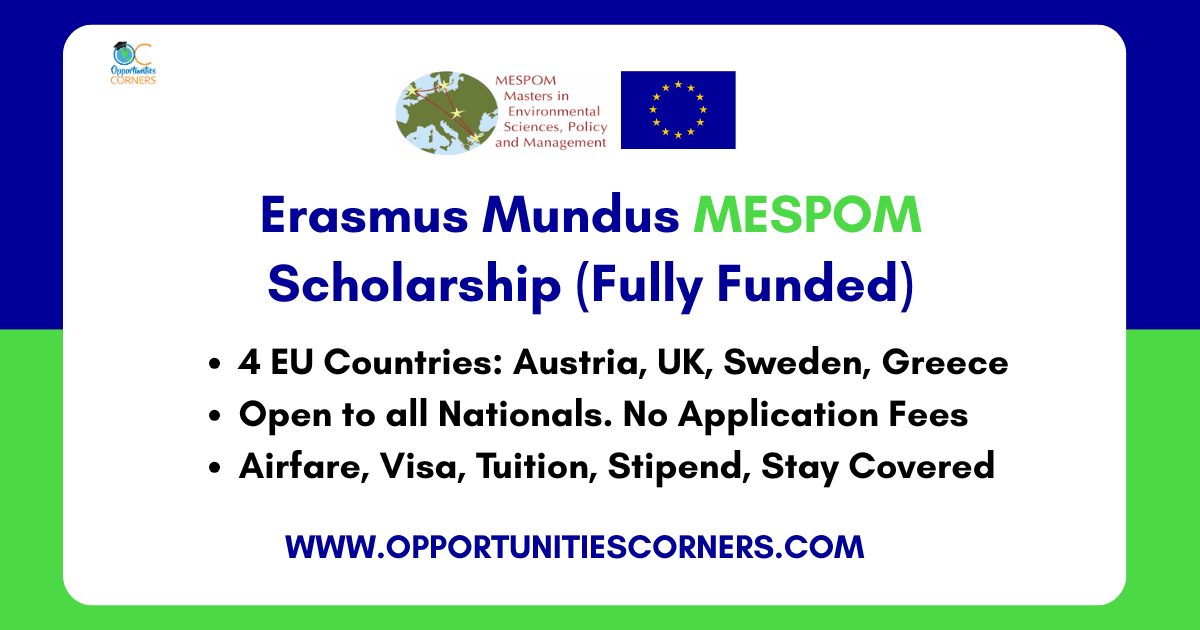
Erasmus Mundus MESPOM Scholarship Opens Applications for 2026-2028 Cohort Applications are now being accepted for the Erasmus Mundus MESPOM (Master's in Environmental Science, Policy, and Management) Scholarship program for the academic years 2026-2028. This fully funded scholarship offers students the opportunity to pursue a joint Master's degree at four prestigious European universities, covering tuition, travel, visa costs, and living expenses.
A Multi-National Educational Experience The MESPOM program is a collaborative effort between Central European University (Austria), Lund University (Sweden), the University of Manchester (UK), and the University of the Aegean (Greece). Students will spend time at each institution, gaining a diverse perspective on environmental challenges and solutions. The program structure includes:
First Year (Fall and Winter): Central European University (Vienna, Austria) Fall Term of the Second Year: Lund University (Sweden) or University of Manchester (UK) Spring Term: University of the Aegean (Lesvos, Greece) Summer Term: Internship supervised by MESPOM Faculty Thesis Term: Students can choose any of the participating institutes based on their academic and professional interests.
Comprehensive Financial Support The Erasmus Mundus scholarship provides extensive financial assistance to selected students, alleviating the burden of educational costs. The scholarship covers:
Travel Costs Visa Costs Monthly Allowance Installation Cost Subsistence Costs Tuition Fees
Career Prospects for MESPOM Graduates Graduates of the MESPOM program are well-prepared for a variety of careers in the environmental sector. Alumni have found employment in:
Government Agencies The United Nations Universities and Research Institutions Businesses Non-Profit Organizations
Many graduates return to their home countries to contribute to environmental initiatives, while others remain in Europe to pursue PhD degrees and further their research.
Eligibility Requirements The Erasmus MESPOM Scholarship is open to applicants from all countries. To be eligible, candidates must meet the following criteria:
Hold a bachelor's degree in a related field such as environmental sciences, policy or management, natural or social sciences, engineering, or management. Candidates from other fields may be considered if they demonstrate a strong commitment to environmental issues through volunteer or professional experience. Demonstrate proficiency in English. (Check the official website for information on English Language Test Exemptions).
Application Process The application process is managed by the Central European University on behalf of the MESPOM Consortium. There is no application fee. Interested candidates must apply online through the CEU website. The application deadline is January 7th, 2026.
The Importance of International Scholarship Programs International scholarship programs like Erasmus Mundus play a crucial role in fostering global collaboration and addressing pressing global challenges. "These programs are vital for cultivating a new generation of environmental leaders who possess the knowledge and skills to tackle complex issues like climate change and resource management," says Dr. Anya Sharma, a professor of environmental policy at the University of California, Berkeley. "By providing opportunities for students from diverse backgrounds to study and collaborate, Erasmus Mundus helps to build a more interconnected and resilient world."
Historical Context and Evolution of Erasmus Mundus The Erasmus Mundus program, established by the European Union, represents a significant investment in international education. Its roots can be traced back to the broader Erasmus program, which initially focused on student mobility within Europe. Over time, the program expanded to include partnerships with universities worldwide, leading to the creation of Erasmus Mundus. This evolution reflects a growing recognition of the importance of international collaboration in addressing global challenges and promoting cross-cultural understanding.
The Broader Impact on Education and Research Beyond individual student benefits, programs like Erasmus Mundus contribute to the overall advancement of education and research. Dr. Ben Carter, a researcher specializing in international education trends at Oxford University, notes, "These programs foster innovation by bringing together diverse perspectives and approaches. The collaborative research projects that often emerge from these partnerships can lead to breakthroughs in various fields, ultimately benefiting society as a whole." Furthermore, the rigorous academic standards and international exposure provided by Erasmus Mundus programs enhance the quality of education at participating institutions, creating a ripple effect that extends beyond the program itself.
Originally sourced from: Opportunities Corners