
Artist explores the toxic mining legacy of Zambia's 'black mountains'
Zambian Artist Exposes Toxic Legacy of Copper Mining Through Art
Lusaka - Stary Mwaba, a prominent Zambian visual artist, is using his art to shed light on the devastating social and environmental consequences of decades of copper mining in the country's Copperbelt region. His latest exhibition at the Lusaka National Museum focuses on the lives of young people who scavenge for copper ore in the "black mountains" – vast, toxic heaps of mining waste that dominate the landscape.
Mwaba's work provides a powerful commentary on the complex realities of life in the Copperbelt, where economic hardship forces many to risk their lives in dangerous and often illegal mining activities.
'Mu Danger': A Childhood Haunting
Mwaba, who grew up in the Copperbelt, remembers the "black mountains" as a forbidden place. "As kids, we used to call it 'mu danger' – meaning 'in the danger'," he tells the BBC. "But we would sneak in anyway, to pick the wild fruits that somehow managed to grow there."
Today, the "black mountains" are a source of livelihood for many young men who dig deep, meandering tunnels to extract copper fragments from the stony slag. They sell the ore to predominantly Chinese buyers, who then process it. The work is arduous, dangerous, and often fatal, but with youth unemployment around 45% in the region, it is often the only option for survival.
Portraits of Survival: Art as a Voice for the Voiceless
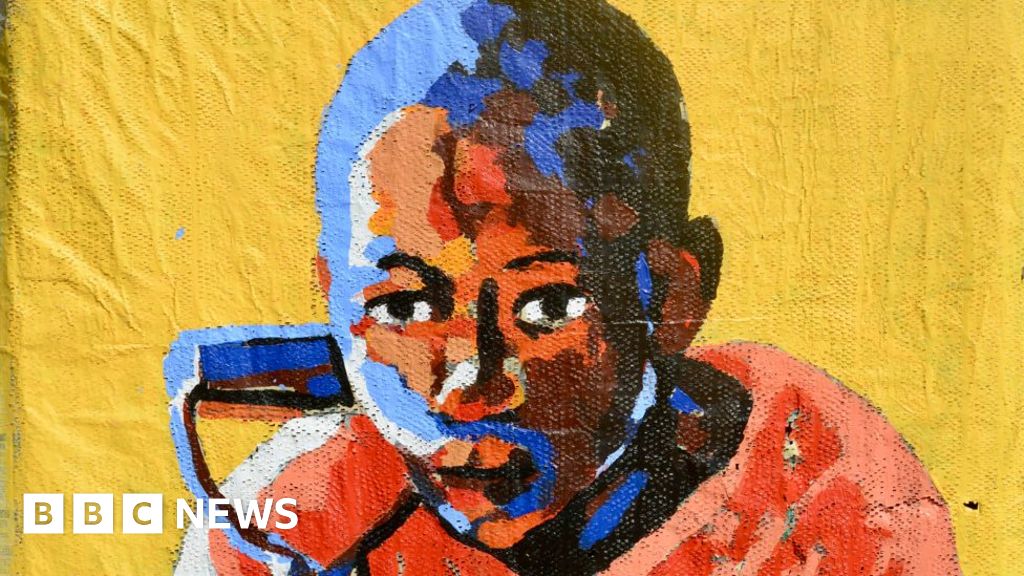
Mwaba's art captures the daily lives and struggles of these young miners and the residents of the Wusakile neighbourhood in Kitwe. He paints large portraits on canvases made of old newspapers, using a soldering gun to burn away parts of the articles, creating perforations that obscure the "grand narratives." He then pours paint into the holes to create portraits, or "little narratives," of the people he knows.
"I take these grand narratives, and I create holes so that you can't make sense of the stories any more. I then impose images of people I know on to them – to show that little stories, the little narratives of ordinary people also count," Mwaba explains. "They have stories that are important and are part of the bigger story."
The 'Jerabos' and a Hierarchy of Exploitation
The young miners often work for gang masters known as "jerabos," a corruption of "jail boys," hinting at their perceived criminality. These "jerabos" control access to the dumpsites, creating a hierarchy of exploitation where the profits are concentrated at the top, leaving the young miners with little control over their futures.
One of Mwaba's paintings, "Boss for a Day," reflects the frustration and sense of exploitation felt by these young miners. It depicts a young man standing confidently with his hands on his hips, a pose that reflects his dreams of empowerment, born out of a workshop where Mwaba encouraged participants to express their hopes through photography.
A Century of Mining, A Legacy of Toxicity
The "black mountains" are the toxic legacy of a century of industrial mining production in Zambia, one of the world's leading copper and cobalt producers. Since the early 1930s, millions of tonnes of waste, full of toxic heavy metals, have been dumped at the site, wreaking havoc on people's health and the environment.
Earlier this year, the water supply to Kitwe, home to about 700,000 people, was shut down after a catastrophic spill of waste from a nearby Chinese-owned copper mine into the streams that flow through neighbourhoods like Wusakile and into the Kafue River, one of Zambia's most important waterways.
Expert View: The Environmental Cost of Copper
Dr. Gilbert Tembo, an environmental scientist at the University of Zambia, emphasizes the long-term environmental impact of the mining waste. "The heavy metals in these dumpsites leach into the soil and water, contaminating the environment and posing serious health risks to the communities living nearby," he says. "We need urgent action to remediate these sites and prevent further pollution."
Historical Context: Privatisation and Economic Crisis
Zambia's mining sector has undergone significant changes over the past few decades. In 1997, the country's mines were privatized, leading to massive job losses and an unprecedented economic crisis in the Copperbelt. This resulted in the "black mountain" becoming a desperate source of income for many who lost their jobs.
According to economist, Chibwe Mutale, "Privatisation, while intended to boost the economy, had unintended consequences for the Copperbelt. The subsequent job losses forced many into informal and dangerous mining activities, exacerbating the problems associated with the 'black mountains'."
Art as a Catalyst for Change
Mwaba's art is not just a reflection of the problems, but also a potential catalyst for change. He recalls an older "jerabo" who attended one of his workshops and expressed a desire for his younger brother to pursue a different path, recognizing the dangers and limitations of the mining life. This highlights the power of art to raise awareness and inspire positive change within the community.
Originally sourced from: BBC News Africa